
2011-2025
Domestic and international calls: over 34,000 funded projects with budget over 19.7 billion PLN.
Domestic calls:
- 157,423 received proposals
- 33,027 funded projects
- 23,807 grant winners
- 18.53 PLN billion in grants
- 61,773 applicants
Early-stage researchers
The NCN launches calls for proposals addressed to early-stage researchers at any stage of their research career. The call portfolio includes programmes designed for scientists at the onset of their career, experienced researchers as well as programmes in which early-stage researchers compete with their experienced colleagues.
- Applicants are usually researchers who are up to 40-45 years old and whose PhD was awarded within the last 12 years.
- In 2024, the NCN allocated over PLN 1.9 billion for research, 51% of which was designated to support the development of early-stage researchers.
- Between 2016 (when the measurements started) and 2024, the NCN awarded a total of PLN 6.3 billion to support the development of early-stage researchers, which accounted for 43% of the total amount awarded for domestic and international calls.
- 658 research projects were allocated funding under the calls for early-stage researchers concluded in 2024 and 667 projects received funding under the calls for researchers at any stage of their research career, accounting for 48 percent of 1,536 projects funded that year.
Thanks to NCN grants, early-stage researchers can carry out their projects, build their own research teams, enjoy PhD scholarships and find employment in Polish research centres. There already exists a whole generation of young people (informally known as “the NCN generation”) who have come of age as researchers beneath the wings of the agency. Access to funding awarded via a reliable procedure dominated by international experts (free of nepotism or political concerns) has encouraged them to stay in Poland or return to Poland.
Number of years in research and age, in Polish (pdf)
NCN funding for early-stage researchers, in Polish (pdf)
Early-stage researchers in NCN calls (podcast)
NCN Grants in Poland. Regional differences
NCN funding per region differs mainly due to the concentration of research institutions, scale of their operations and quality of research carried out in various regions of Poland. The largest number of grants goes to the Mazowieckie Voivodeship and Małopolskie Voivodeship, although other institutions also reach considerable results.
- Between 2011 and 2024, 42.8% of NCN proposals came from the Mazowieckie Voivodeship and Małopolskie Voivodeship (26.6% and 16.2%, respectively) because they have the largest number of research institutions, such as research institutes of the Polish Academy of Sciences, research academies and other active research institutions. The largest number of researchers is also employed in these two regions. As compared to Poland’s other regions (voivodeships), Mazowieckie Voivodeship has the largest number of research institutions labelled with the scientific categories A+ and A, which indicate the highest quality research (followed by the Małopolskie Voivodeship and Wielkopolskie Voivodeship).
- Researchers from the Lubuskie Voivodeship, Świętokrzyskie Voivodeship and Opolskie Voivodeship are the least active in the grant system. Their share in the total number of submitted proposals and awarded funding is below 1%.
- NCN call results between 2011 and 2024 correspond to the applicants’ activities, with 31.7% of projects recommended for funding submitted by researchers from the Mazowieckie Voivodeship and 18.4% from the Małopolskie Voivodeship.
- Apart from those two regions, other institutions effectively compete for NCN grants. The success rates of researchers from the Wielkopolskie Voivodeship and Dolnośląskie Voivodeship is above the national average (approximately 23% with the national average of over 21%). Funding awarded to researchers from the Pomorskie Voivodeship and Łódzkie Voivodeship regions was similar to or above the national average. This shows that high-quality research is carried out in various research institutions around Poland.
- The NCN proposal system is quality-based. Experts, who are mainly (over 90%) foreign researchers, do not evaluate institutions that host the research and funding is awarded to projects with the best merit-based evaluation results.
- Grant success also depends on the type of institution. The largest number of grantees are scientists employed by research institutes of the Polish Academy of Sciences. Although universities are the most numerous among the applying institutions, their performance varies greatly, which may be related to the fact that the obligations of their employees is often very diverse. Research institutes and institutions labelled as “other” are less effective.
The NCN takes measures to support smaller academic centres. It promotes academic mobility, introduces caps on the number of grants per institution, launches regular MINIATURA calls and organises applicant training courses and NCN Days outside of the largest cities. In 2025 NCN Days took place in Rzeszów.
Number of submitted proposals, budgets, entities, applicants – per voivodeship, in Polish (pdf)
Equal access of women and men to research funding
The NCN has consistently prioritised equal access to research funding for men and women. In 2022, we adopted a new NCN Gender Equality Plan. We also publish regular data on women’s participation in NCN-funded projects.
- The analysis of the grant activity shows that the distribution of women and men in the number of submitted proposals is almost identical. Between 2011 and 2024, NCN calls attracted over 29.6 thousand female researchers and over 29 thousand male researchers.
- A slight difference in the effectiveness (40% man and 37% women) may suggest that female researchers encounter certain hurdles when attempting to acquire funding. It also shows that we must continue to monitor the situation and provide support, if needed.
Gender participation in NCN-funded projects, in Polish (pdf)
Men and women in science (podcast)
NCN experts
Proposals submitted to NCN calls are evaluated by Polish and foreign researchers, who sit on Expert teams, as well as external peer reviewers, whose decisions are exclusively based on criteria of scientific excellence and involve no conflict of interest.
- In 2023, proposals were evaluated by a total of 2207 experts and 8321 peer reviewers. Nearly 98% of reviewers and over 91% of experts are researchers affiliated with foreign research institutions. The largest percentage of researchers with a foreign affiliation is within Physical Sciences and Engineering, the lowest within Arts, Humanities and Social Sciences. The internationalisation within Life Sciences and Physical Sciences and Engineering exceeds 99%.
- Proposals submitted to the National Science Centre between 2011 and 2023 were evaluated mainly by researchers employed in the USA, UK, Germany, Italy, France and Spain.
- Nearly all experts participating in the evaluation process between 2017 and 2023 (almost 5,000 people) have worked as principal investigators (95% on average and 92% in 2023). Most had also served as peer reviewers in other grant agencies (87% on average and almost 95% in 2022) and NCN Expert Team members.
- Nearly all experts who took part in the internal NCN evaluation process between 2021 and 2023 (over 6,000 people) were also peer reviewers in scientific journals (99%) and other grant agencies (91% on average) and worked as principal investigators (80% on average).
Names and affiliations of NCN experts and peer reviewers.
NCN budget
A low budget of the National Science Centre has been a huge challenge making it impossible to fund many good research projects. The budget increase over the last months significantly supported research but did not compensate for the inflation accrued between 2020 and 2024.
- Pursuant to the 2025 Budget Bill that came into effect on 20 January 2025, the NCN budget will total PLN 1,748 billion, including PLN 1,684 million for research projects and of PLN 63,4 million for operational activity.
- On 29 November 2024, Polish PM Donald Tusk announced that the NCN will be allocated PLN 500 million in bonds to be used in the future. On 17 December 2024, NCN received funds with a nominal value of PLN 500 mln and maturity date of 2027–2034. Certain doubts had, however, arisen as to whether it could be used for research without the NCN Act being amended. Further legal analyses had to be performed and additional funds acquired. On 20 August 2025, following the opinion of the Ministry of Finance, it was decided that bonds could be included in the projected NCN funding for future years.
- Researchers continue to appeal and request that 2026 funding be increased. In the Resolution of 21 September, the NCN Council expressed its concerns related to the fact that the draft Budget Act 2026 adopted by the Council of Ministers at the end of August, did not provide for any increase in research funding. A demand was sent to public authorities requesting that research funding (including NCN funding) be increased.
- We are convinced that striving to regain the success rate of approximately 25% must be our top priority so that researchers have a real chance to turn their ideas into reality. With a low success rate, many researchers have no access to grant funding, research development is limited, and the quality of education decreased. Sustainable development and innovation cannot be achieved without basic research.
An increase in the subsidy would be impossible without the involvement of the scientific community supporting the NCN and advocating for its budget to be increased.
Former state of affairs:
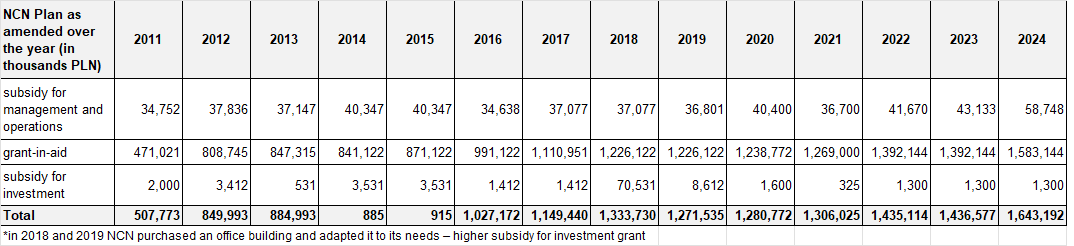
- In 2024, the state budget included PLN 31.349 billion for higher education and science which means that only 5.2% of the state budget (over PLN 1.643 billion) was designated for NCN research-funding operations.
- The said PLN 1.643 billion includes PLN 200 million the National Science Centre received from the Ministry of Science and Higher Education so far.
- The additional PLN 200 million allowed us to fund 584 highly ranked projects on the waiting lists. Funding was awarded to 322 projects on the waiting lists under OPUS 25, PRELUDIUM 22, MAESTRO 15 and SONATA BIS 13 and 262 under OPUS 26 and SONATA 19.
- Recently, the NCN budget has been virtually frozen. In 2015, funds for research from the state budget amounted to PLN 871 million. Three years later, the amount went up to PLN 1.226 billion, in 2022, it went up to PLN 1.392 billion and in 2023, it remained the same. This means that between 2015 and 2018, the NCN budget went up by over 40%, and between 2018 and 2023, by merely 13%.
- A few years ago, the NCN success rate was ca. 25%. As a consequence of the NCN being poorly funded by the state and the cost of research increasing (due to a drastic increase in the prices of services, materials and research equipment), the success rate dropped to 17% in 2022 and (in some calls) even below 10% in 2023. In the calls concluded in 2024, following an increase in the NCN funding, the success rate went up by more than ten percent (15% in OPUS 26 and 19% in SONATA 19).
2023 infomation:
Funding appeals by the NCN Director and Council President
Appeals by the Chairs of international panels evaluating proposals under NCN calls