Principal Investigator
:
Prof. Dr hab. Mikołaj Czajkowski
University of Warsaw
Panel: HS4
Funding scheme
: OPUS 13
announced on
15 March 2017
Every day we choose between a bike lane and a traffic jam, between smog and lower electricity prices. Economists attempt to measure how much we truly value such things, even when they have no market price. To do so, we use stated preference (SP) research: carefully designed surveys with hypothetical choices that function like an economic microscope, revealing what the market does not show. The problem is that human minds rely on shortcuts — anchors, simplifications, fatigue — that can blur this picture. Our project aims to detect these distortions, understand them, and learn how to correct them.
 Prof. Dr hab. Michał Czajkowski, photo: Łukasz Bera
The goal is both simple and ambitious: to improve the validity and robustness of SP methods in the face of behavioural phenomena (such as anchoring, insufficient sensitivity to scope, or partial information processing). We systematically investigate when and why these effects arise and how surveys and models should be designed to yield stable, truthful results. The outcome? Better numbers for better public decisions — from environmental policy and transport to healthcare.
Prof. Dr hab. Michał Czajkowski, photo: Łukasz Bera
The goal is both simple and ambitious: to improve the validity and robustness of SP methods in the face of behavioural phenomena (such as anchoring, insufficient sensitivity to scope, or partial information processing). We systematically investigate when and why these effects arise and how surveys and models should be designed to yield stable, truthful results. The outcome? Better numbers for better public decisions — from environmental policy and transport to healthcare.
What exactly are we doing? First, we compare situations involving public and private goods: are these “behavioural shallows” less pronounced where people have more experience and information? Second, we examine response quality: we detect “survey sprinters,” test trap‑questions, and assess the effects of survey mode and cognitive burden. Third, we address the problem of attribute non-attendance (e.g. ignoring cost), because without accounting for it we cannot reliably estimate welfare changes. Fourth, we move beyond naive assumptions of constant cost sensitivity. Finally, we compare SP data with “real” choices and test whether people consider all presented options or first narrow their selection to a manageable subset.
Methodologically, we adopt a two-track approach. On the one hand, we reanalyse existing datasets to determine whether “anomalies” stem from modelling errors (for example, overly restrictive distributions in models). On the other hand, we conduct field experiments in which we deliberately vary attribute levels and price vectors to capture and describe anchoring effects (and even mitigate them, for instance through brief preceding questions that help elicit respondents’ own, “at-home” preferences). We will make the model code available as open‑source tools so that good practices can easily spread to future studies.
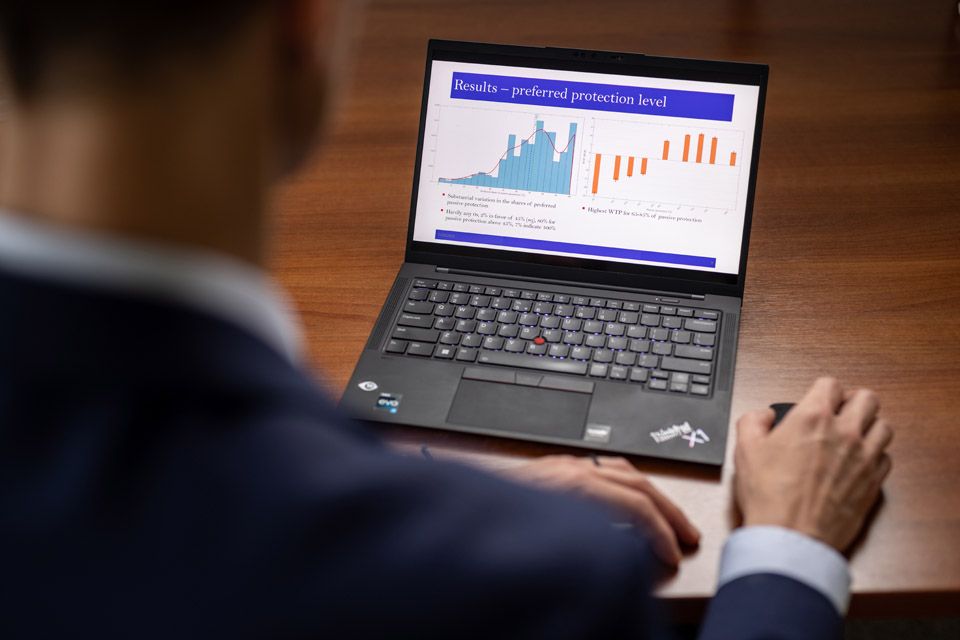 Prof. Dr hab. Michał Czajkowski, photo: Łukasz Bera
Why does this matter? Because SP methods are now one of the pillars of public policy evaluation and service design: they are used in decisions concerning clean water, road planning, the valuation of travel time, and health outcomes. If a survey inadvertently “suggests” numbers that are too high or too low, policymakers receive an unreliable guide. Our project will provide a set of maps and compasses: implementation guidelines, quality-control procedures, more appropriate models (including those linking decisions about “whether” with decisions about “how much”), and ultimately practical recommendations for public administration and researchers.
Prof. Dr hab. Michał Czajkowski, photo: Łukasz Bera
Why does this matter? Because SP methods are now one of the pillars of public policy evaluation and service design: they are used in decisions concerning clean water, road planning, the valuation of travel time, and health outcomes. If a survey inadvertently “suggests” numbers that are too high or too low, policymakers receive an unreliable guide. Our project will provide a set of maps and compasses: implementation guidelines, quality-control procedures, more appropriate models (including those linking decisions about “whether” with decisions about “how much”), and ultimately practical recommendations for public administration and researchers.
Most noteworthy expected outcomes:
- a precise diagnosis of when anchors “attach” to responses and how they can be neutralised in practice (through the selection of levels, task order, and brief priming);
- demonstration of the conditions under which the issue lies not with psychology but with an overly simplistic model — and how to remedy this;
- quality checklists (deliberation time, attention traps, confidence calibration) and design guidelines for SP studies;
- publicly available model code and publications in leading journals so that standards across the field can improve sustainably.
In short, we teach SP methods to better accommodate human nature — with all its cleverness, haste, and reliance on shortcuts. As a result, the values we obtain will more closely reflect what people truly think and feel, and public decisions will be more sound.
Project title: Incentive Compatibility in Stated Preference Studies
Prof. Dr hab. Mikołaj Czajkowski
An economist specialising in preference modelling and the valuation of non-market goods. He combines SP survey methods with behavioural economics and modern econometrics to deliver reliable estimates for public policies. Author of numerous publications and collaborator with international research teams. In his projects, he emphasises open-source software, good research practices, and the development of early-career researchers.