Principal Investigator
:
Dr hab. Damian Guzek, Prof. UŚ
University of Silesia
Panel: HS5
Funding scheme
: T-AP
announced on
15 June 2023
Social bonds and trust-based relationships constitute the foundation of stable democracies. They enable cooperation between citizens and political actors — politicians, civil servants, and journalists — fostering a sense of community and supporting civic engagement. Public trust is a key social resource; however, it has been eroding in recent years. Polarisation, disinformation, the instrumentalisation of emotions in public debate, and the growing number of anti-civic incidents weaken the foundations of communication between citizens and political institutions. In this context, digital technology is perceived both as a threat and as a potential tool for rebuilding trust-based relationships.
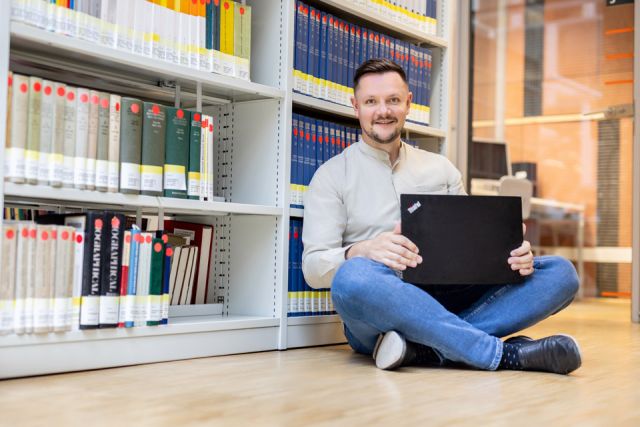
 Dr hab. Damian Guzek, Prof. UŚ, photo: Łukasz Bera
The project “The Potential of Digital Technology. Optimising Trustworthy Digital Contact” focuses on analysing how various forms of digital communication may strengthen or weaken political trust. The starting point is earlier research on citizens’ preferences regarding contact with political actors — its frequency, forms, and channels. This project, however, concentrates on a comparative examination of which digital touchpoints — email, social media, chatbots, political influencers, or messages generated by artificial intelligence — foster trustworthy relationships and which generate distance, uncertainty, and a sense of manipulation.
Dr hab. Damian Guzek, Prof. UŚ, photo: Łukasz Bera
The project “The Potential of Digital Technology. Optimising Trustworthy Digital Contact” focuses on analysing how various forms of digital communication may strengthen or weaken political trust. The starting point is earlier research on citizens’ preferences regarding contact with political actors — its frequency, forms, and channels. This project, however, concentrates on a comparative examination of which digital touchpoints — email, social media, chatbots, political influencers, or messages generated by artificial intelligence — foster trustworthy relationships and which generate distance, uncertainty, and a sense of manipulation.
In this project, particular attention is devoted to communities that traditionally experience marginalisation in political communication processes. We assume that women, ethnic minorities, and diasporas may have distinct needs and expectations regarding how political elites communicate, and may respond differently to specific formats of digital contact. We therefore analyse how identity-based and cultural differences influence perceptions of the credibility and authenticity of digital political communication.
The research is conducted in four countries — Canada, France, Poland, and the United Kingdom — and is based on in-depth interviews, surveys, and an experiment. It aims to determine to what extent and in what ways particular forms of digital interaction can be optimised so that they promote trust rather than reinforce existing inequalities. Ultimately, the project seeks to develop a model of ethical and inclusive digital communication that will not only increase the effectiveness of political messaging but also counteract exclusion and discrimination.
 Dr hab. Damian Guzek, Prof. UŚ, photo: Łukasz Bera
The project will also provide theoretical knowledge on whether it is possible to speak of a single universal model of trustworthy communication, or rather of competing concepts of trust and authenticity that differ depending on the social and political context. At a later stage, we plan to ask both representatives of political elites and citizens about their responses to the tested communication strategies. This will make it possible to determine which solutions are not only effective but also realistic and feasible for implementation in public life.
Dr hab. Damian Guzek, Prof. UŚ, photo: Łukasz Bera
The project will also provide theoretical knowledge on whether it is possible to speak of a single universal model of trustworthy communication, or rather of competing concepts of trust and authenticity that differ depending on the social and political context. At a later stage, we plan to ask both representatives of political elites and citizens about their responses to the tested communication strategies. This will make it possible to determine which solutions are not only effective but also realistic and feasible for implementation in public life.
The project has a diagnostic and normative character: it not only analyses the state of trust-based relationships in the digital era but also identifies ways of rebuilding them. As a result, it will be possible to formulate recommendations concerning the principles of ethical political communication in the digital environment and to create a framework for the responsible use of technology in citizen–state relations.
Project title: The Potential of Digital Technology. Optimising Trustworthy Digital Contact
Dr hab. Damian Guzek, Prof. UŚ
Professor Damian Guzek, professor at the University of Silesia, is a researcher specialising in digital communication, politics, and religion, affiliated with the University of Silesia in Katowice and Palacký University in Olomouc. He leads Polish research teams in the NCN PODTRUST and INFLUPOL project consortia. He is a member of the Committee on Media and Communication of the Polish Academy of Sciences, the Steering Committee of the Monitoring Electoral Democracy (MEDem) programme, and the Advisory Board of the Network for New Media, Religion and Digital Culture Studies.