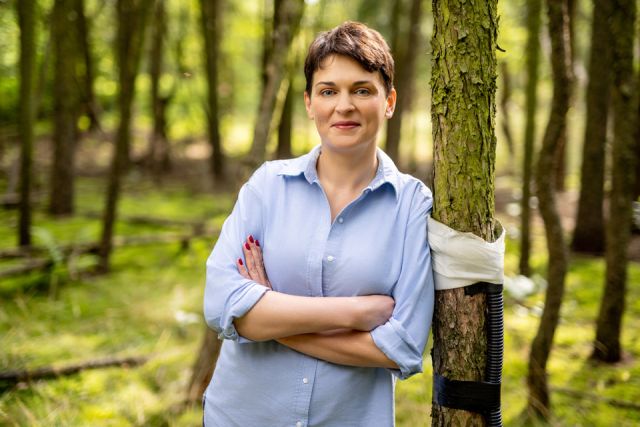
Principal Investigator
:
Dr hab. inż. Anna Ilek
Poznań University of Life Sciences
Panel: NZ9
Funding scheme
: OPUS 22
announced on
15 September 2021
Climate change is leading to increasingly frequent and prolonged drought periods, which limit water availability in forest ecosystems. Water scarcity adversely affects forest functioning, particularly during the growing season — a period of intensive tree growth and development. Drought can lead to reduced biomass increment, hinder forest regeneration and lower tree resistance to diseases and pests.
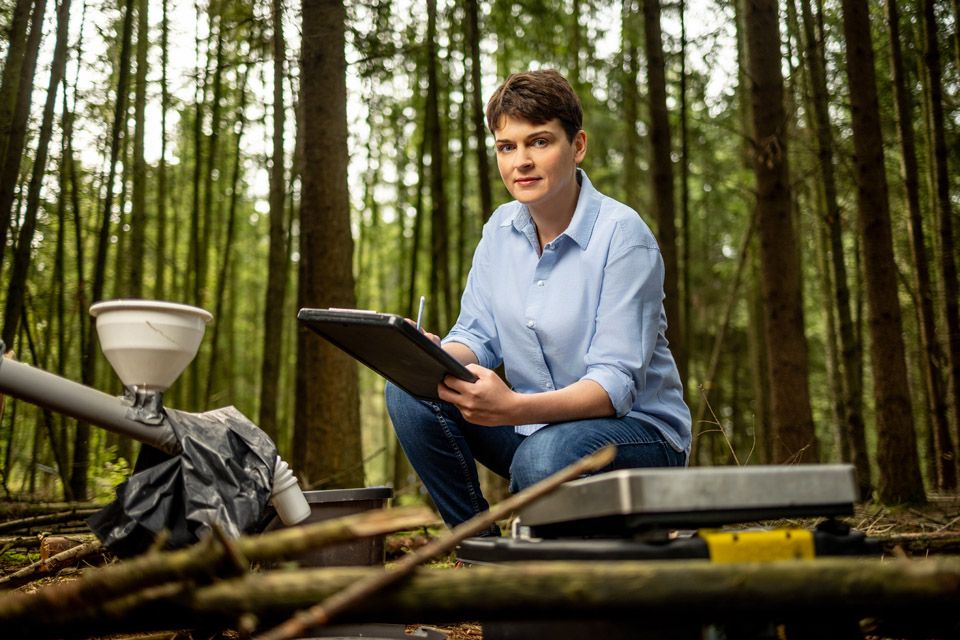 Dr hab. inż. Anna Ilek, photo: Łukasz Bera
Forests play a key role in the water cycle — they store water in the soil and slow its outflow. Each forest, depending on its dominant tree species, manages water differently, meaning they differ in how precipitation is intercepted and redistributed. This variation arises, among other factors, from differences in canopy architecture, leaf or needle shape, bark structure, tree height, stem thickness and tree density. Some species retain a significant portion of rainfall in the canopy, while others more effectively transmit water to the soil via throughfall or stemflow.
Dr hab. inż. Anna Ilek, photo: Łukasz Bera
Forests play a key role in the water cycle — they store water in the soil and slow its outflow. Each forest, depending on its dominant tree species, manages water differently, meaning they differ in how precipitation is intercepted and redistributed. This variation arises, among other factors, from differences in canopy architecture, leaf or needle shape, bark structure, tree height, stem thickness and tree density. Some species retain a significant portion of rainfall in the canopy, while others more effectively transmit water to the soil via throughfall or stemflow.
Trees also influence the water balance indirectly through the quality of the organic matter (leaves, needles, fine roots) they contribute to the soil. From this organic matter, organic and humic horizons develop that perform an important function in retaining and redistributing water. The surface soil layers act as natural buffers — absorbing water after precipitation and regulating its further movement deeper into the soil profile. Their physical and chemical properties are largely determined by the tree species under which they form.
Understanding how different tree species affect precipitation redistribution and soil water-retention and infiltration capacity is the main objective of the project carried out at the Poznań University of Life Sciences, in collaboration with the Hugo Kołłątaj University of Agriculture in Kraków. Research focuses on assessing the impact of tree-species composition on soil water retention and movement processes, and on how these processes change under prolonged precipitation deficit. The project also aims to identify characteristics of organic matter and tree species that particularly favour water retention and infiltration.
Experiments are conducted at the Experimental Forest Station in Siemianice in even-aged monocultures of ten tree species (including Scots pine, lime, oak, beech and Douglas fir) growing under identical soil and climatic conditions. Such a design allows precise comparison of the influence of individual species on the water cycle, including rainfall redistribution (interception, stemflow, throughfall), litter water repellency and water absorption, as well as soil infiltration rates and water-retention capacity. In parallel, the physical and chemical properties of organic matter that govern the efficiency of these processes are analysed.
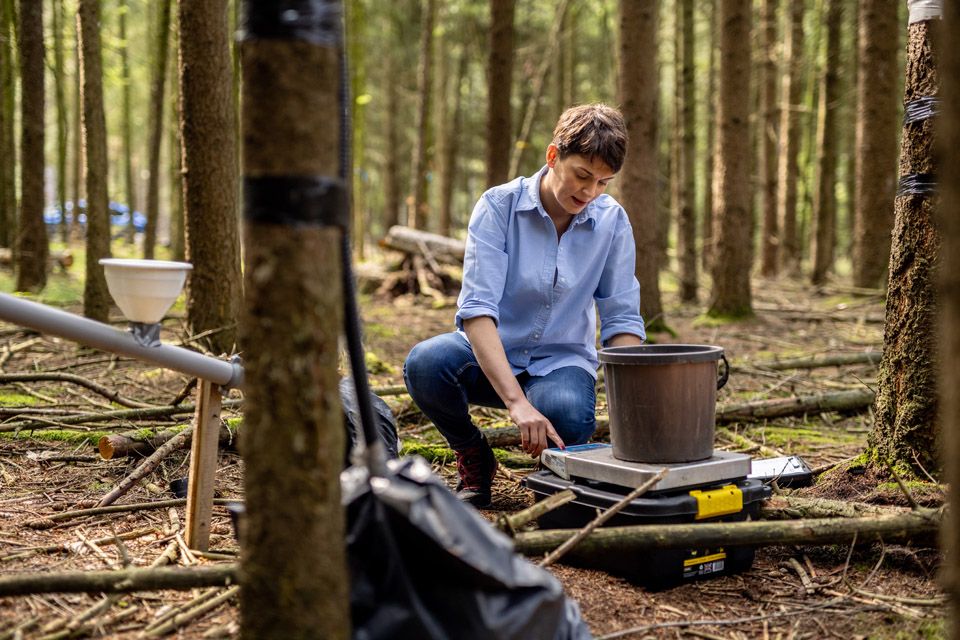 Dr hab. inż. Anna Ilek, photo: Łukasz Bera
Preliminary results indicate that tree species significantly differentiate water cycling in forest ecosystems. Deciduous forests generally transmit a larger portion of precipitation to the soil — both as throughfall and stemflow. In contrast, coniferous forests are more “impermeable”, meaning that a larger fraction of water is retained in the canopy and evaporates, rather than entering the soil. Deciduous species such as lime, maple and sycamore promote high soil biological activity and efficient nutrient cycling. Organic matter derived from these trees maintains high water conductivity even after dry spells, allowing water to penetrate effectively into deeper soil layers. Conversely, species such as Douglas fir and larch produce needle litter that forms organic layers with low decomposability and increased water repellency, which inhibits water infiltration and reduces the soil’s capacity to retain water.
Dr hab. inż. Anna Ilek, photo: Łukasz Bera
Preliminary results indicate that tree species significantly differentiate water cycling in forest ecosystems. Deciduous forests generally transmit a larger portion of precipitation to the soil — both as throughfall and stemflow. In contrast, coniferous forests are more “impermeable”, meaning that a larger fraction of water is retained in the canopy and evaporates, rather than entering the soil. Deciduous species such as lime, maple and sycamore promote high soil biological activity and efficient nutrient cycling. Organic matter derived from these trees maintains high water conductivity even after dry spells, allowing water to penetrate effectively into deeper soil layers. Conversely, species such as Douglas fir and larch produce needle litter that forms organic layers with low decomposability and increased water repellency, which inhibits water infiltration and reduces the soil’s capacity to retain water.
The results to date unequivocally show that tree-species choice has a significant impact on forest water management. In an era of climate change and increasing drought risk, conscious shaping of tree-species composition can enhance the resistance of stands to water stress and support retention functions that underpin the stability and resilience of forest ecosystems.
Project title: Investigation of the Relationships Between Soil Organic Matter and the Dynamics of Water Infiltration and Retention in Forest Soils in the Context of Climate Change and Tree-Species Composition
Dr hab. inż. Anna Ilek
Defended her doctoral thesis in forest sciences at the University of Agriculture in Kraków and obtained her habilitation at the Poznań University of Life Sciences. Her research focuses on soil infiltration, water repellency and the role of tree species in the water cycle. She has undertaken research stays in the USA, Japan and Brazil. She is the principal investigator of NCN-funded projects. Author and co-author of 30 publications and three patents. She has received the Ministry of Education and Science scholarship for outstanding young researchers and the Polish Academy of Sciences award for the best doctoral thesis.