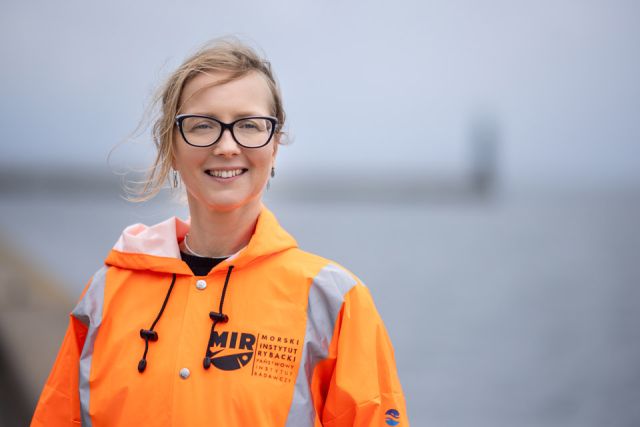
Principal Investigator
:
Dr hab. Katarzyna Piwosz, prof. MIR-PIB
National Marine Fisheries Research Institute
Panel: NZ8
Funding scheme
: Weave-UNISONO
announced on
4 January 2021
Life is green, both on land and in the sea. The turquoise colour of tropical waters results from low fertility and the small number of organisms present, whereas the green waters of the Baltic Sea are teeming with life. This is because life in the seas consists of microorganisms.
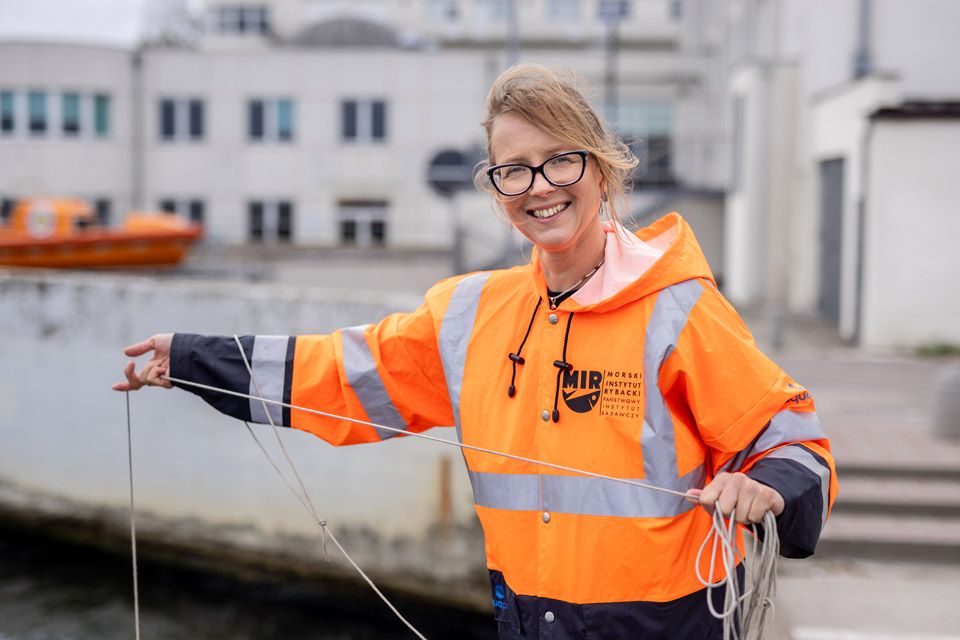 Dr hab. Katarzyna Piwosz, prof. MIR-PIB, photo: Łukasz Bera
Microorganisms — bacteria, archaea and protists (unicellular eukaryotic organisms such as algae and protozoa) — account for 70–90% of marine biomass. They carry out key processes in matter cycling and energy flow without which life would be impossible; for example, diazotrophic bacteria fix atmospheric nitrogen. Another interesting group is photoheterotrophic bacteria. They use solar energy but also require organic matter for growth because, unlike photoautotrophs, they do not fix carbon dioxide. In the bacterial world, they function like hybrid cars. And, similarly to the automotive world, there are two main types of photoheterotrophic bacteria: some contain bacteriorhodopsin, a pigment also found in our eyes, while others — aerobic anoxygenic phototrophic bacteria (AAP) — possess bacteriochlorophyll-based photosystems similar to those found in plants. In our project, we focus on the latter group, as their high activity and substantial biomass make them an important component of aquatic ecosystems.
Dr hab. Katarzyna Piwosz, prof. MIR-PIB, photo: Łukasz Bera
Microorganisms — bacteria, archaea and protists (unicellular eukaryotic organisms such as algae and protozoa) — account for 70–90% of marine biomass. They carry out key processes in matter cycling and energy flow without which life would be impossible; for example, diazotrophic bacteria fix atmospheric nitrogen. Another interesting group is photoheterotrophic bacteria. They use solar energy but also require organic matter for growth because, unlike photoautotrophs, they do not fix carbon dioxide. In the bacterial world, they function like hybrid cars. And, similarly to the automotive world, there are two main types of photoheterotrophic bacteria: some contain bacteriorhodopsin, a pigment also found in our eyes, while others — aerobic anoxygenic phototrophic bacteria (AAP) — possess bacteriochlorophyll-based photosystems similar to those found in plants. In our project, we focus on the latter group, as their high activity and substantial biomass make them an important component of aquatic ecosystems.
The discovery of AAP bacteria in surface ocean waters at the beginning of the millennium overturned the paradigm that marine bacteria are exclusively heterotrophic. Initially, it was assumed that they used solar energy to survive unfavourable conditions of nutrient scarcity frequently occurring far from land. However, subsequent studies demonstrated a positive relationship between the abundance of AAP bacteria and water fertility. In our research conducted in lakes, we discovered that the additional energy derived from light helps them compete with heterotrophic bacteria precisely when food is abundant.(Piwosz et al., 2024, Villena-Alemany et al., 2024) We also demonstrated the key role of these bacteria in the carbon cycle, showing that photoheterotrophy increases its efficiency by approximately 15%.(Piwosz et al., 2022) These findings inspired us to investigate the impact of eutrophication on these processes.
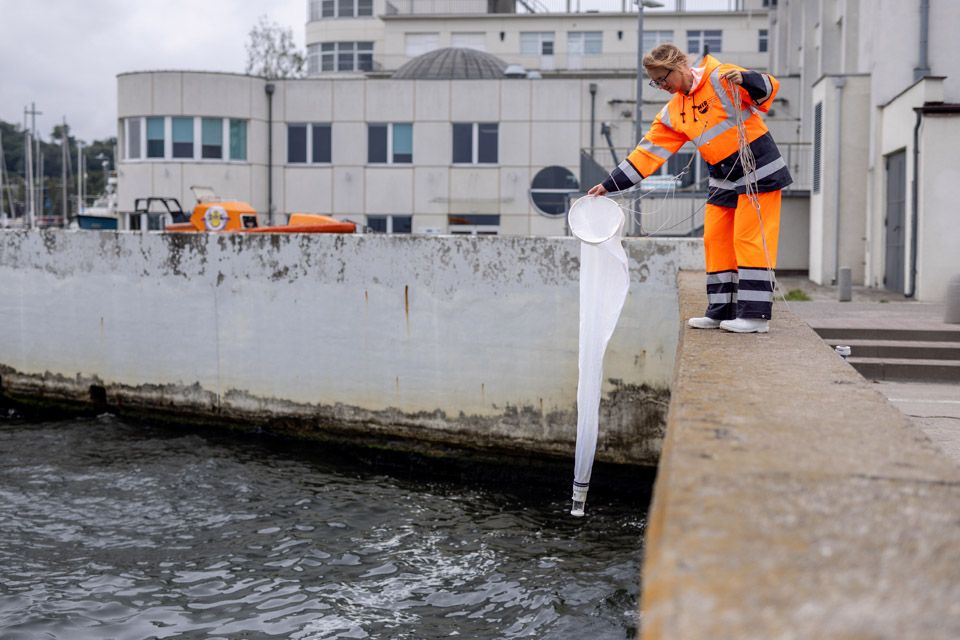 Dr hab. Katarzyna Piwosz, prof. MIR-PIB, photo: Łukasz Bera
Eutrophication, or the over-enrichment of aquatic systems, is a growing problem in both lakes and the Baltic Sea. Excessive inflow of nutrients — inorganic nitrogen and phosphorus compounds — promotes the growth of phytoplankton (algae and cyanobacteria), which in extreme cases forms blooms that colour the water an intense green. The decomposition of this enormous biomass contributes to the formation of anoxic zones. In this way, eutrophication alters the functioning of aquatic ecosystems in ways less favourable to humans, whose activities are the primary cause of eutrophication. The aim of our project, carried out in collaboration with scientists from Germany and the Czech Republic, is to investigate the impact of eutrophication on the biodiversity and activity of AAP bacteria. We anticipate that, as environmental fertility increases, the composition of their communities will change and the importance of photoheterotrophy in the carbon cycle will grow. As a result, oxygen consumption during bloom decomposition may decrease, contributing to a slower expansion of anoxic zones. This may be of considerable importance, for example in the Baltic Sea, where the only studies on AAP bacteria to date were conducted more than 20 years ago.(Masin et al., 2006)
Dr hab. Katarzyna Piwosz, prof. MIR-PIB, photo: Łukasz Bera
Eutrophication, or the over-enrichment of aquatic systems, is a growing problem in both lakes and the Baltic Sea. Excessive inflow of nutrients — inorganic nitrogen and phosphorus compounds — promotes the growth of phytoplankton (algae and cyanobacteria), which in extreme cases forms blooms that colour the water an intense green. The decomposition of this enormous biomass contributes to the formation of anoxic zones. In this way, eutrophication alters the functioning of aquatic ecosystems in ways less favourable to humans, whose activities are the primary cause of eutrophication. The aim of our project, carried out in collaboration with scientists from Germany and the Czech Republic, is to investigate the impact of eutrophication on the biodiversity and activity of AAP bacteria. We anticipate that, as environmental fertility increases, the composition of their communities will change and the importance of photoheterotrophy in the carbon cycle will grow. As a result, oxygen consumption during bloom decomposition may decrease, contributing to a slower expansion of anoxic zones. This may be of considerable importance, for example in the Baltic Sea, where the only studies on AAP bacteria to date were conducted more than 20 years ago.(Masin et al., 2006)
- Masin M, Zdun A, Ston-Egiert J, et al. Seasonal changes and diversity of aerobic anoxygenic phototrophs in the Baltic Sea. Aquat Microb Ecol 2006;45:247-254. https://doi.org/10.3354/ame045247.
- Piwosz K, Villena-Alemany C & Mujakić I. Photoheterotrophy by aerobic anoxygenic bacteria modulates carbon fluxes in a freshwater lake. The ISME Journal 2022;16:1046–1054. https://doi.org/10.1038/s41396-021-01142-2.
- Piwosz K, Villena-Alemany C, Całkiewicz J, et al. Response of aerobic anoxygenic phototrophic bacteria to limitation and availability of organic carbon. FEMS Microbiol Ecol 2024;100:fiae090. https://doi.org/10.1093/femsec/fiae090.
- Villena-Alemany C, Mujakic I, Fecskeova LK, et al. Phenology and ecological role of Aerobic Anoxygenic Phototrophs in fresh waters. Microbiome 2024;12:65. https://doi.org/10.1186/s40168-024-01786-0.
Project title: Eutrophication vs Photoheterotrophic Bacteria: Changes in the Contribution of Aerobic Anoxygenic Photoheterotrophic Bacteria to Bacterial Community Dynamics and the Carbon Cycle Depending on the Trophic Status of the Environment
Dr hab. Katarzyna Piwosz, prof. MIR-PIB
She became interested in microorganisms in her third year of Oceanography studies at the University of Gdańsk. After obtaining a Master’s degree in Arctic phytoplankton ecology, she continued her studies in Germany at the International Max Planck Research School of the Max Planck Institute for Marine Microbiology in Bremen. She completed her doctoral degree in Earth sciences at the Institute of Oceanology of the Polish Academy of Sciences in close collaboration with the University of Zurich. She has led more than ten research projects, including five international ones. She serves as an ambassador for the International Society for Microbial Ecology, and her work was recognised with the award for Best Ambassador for 2019–2020. In her free time, she enjoys sewing, sailing and life.