
713 OPUS and PRELUDIUM grants from the National Science Centre will be received by researchers to carry out basic research at Polish research institutions. The total budget of the projects recommended for funding amounts to nearly PLN 700 million.
 The calls concluded are part of the National Science Centre’s flagship funding offer and have been announced regularly for almost 15 years. They are addressed to researchers planning to carry out research projects at Polish host institutions. The thematic scope is unrestricted — we provide funding for all research domains: from the Humanities, Social Sciences and Art Sciences (HS), through the Physical Sciences and Engineering (ST), to the Life Sciences (NZ). All projects must fall within the scope of basic research.
The OPUS funding scheme is addressed to all researchers, regardless of their career stage, age, or level of experience. Grants may be implemented with or without the participation of foreign partners and may involve the use of large international research equipment, such as particle accelerators, research reactors, lasers, telescopes, etc. An OPUS project may be planned for a duration of one, two, three, or four years. There are no budget limits or predefined requirements regarding the composition of the research team. Grants may be used, among other things, for salaries, scholarships, the purchase of research equipment, devices, software and materials, services, trips, visits, consultations, and other costs crucial to the project.
PRELUDIUM is addressed exclusively to researchers who are not PhD holders. Within this call, applicants may apply for grants with fixed durations and budgets of PLN 70,000, 140,000, or 210,000 for projects lasting one, two, or three years, respectively. The involvement of a mentor supporting the principal investigator is mandatory. The subject matter of the project may be related to the subject of the doctoral dissertation. Defending a doctoral dissertation is not a condition for the settlement of the project.
OPUS 29 ranking short lists in pdf format
PRELUDIUM 24 ranking short lists in pdf format
Statistics
 In both calls, NCN received a total of 5,044 proposals with a total budget of nearly PLN 4.4 billion.
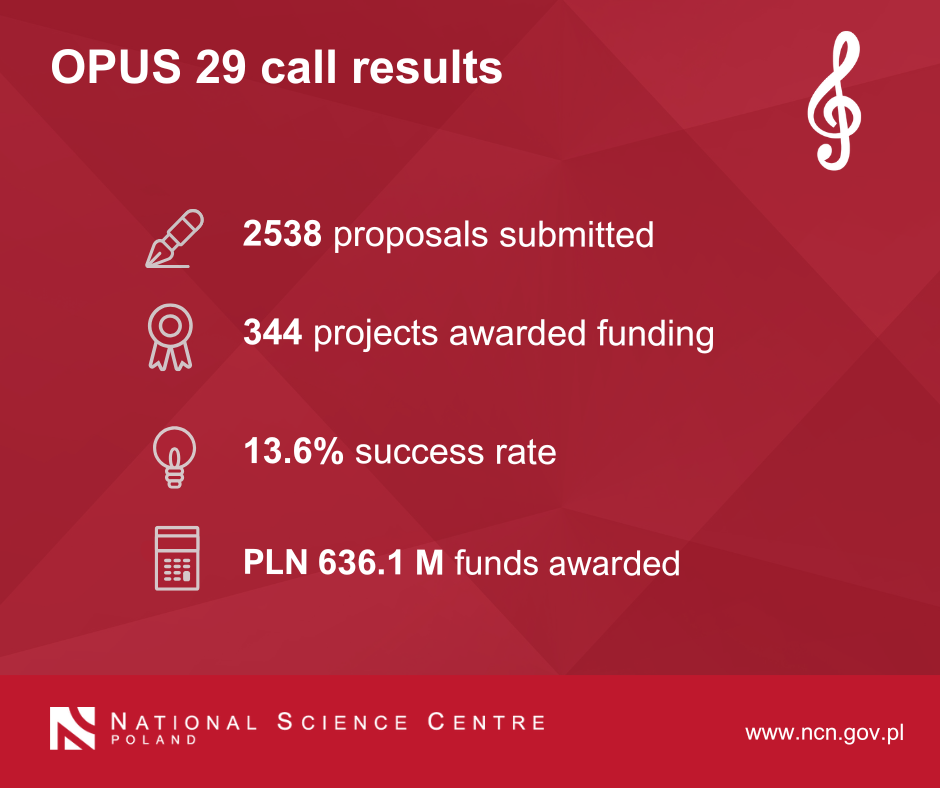
In OPUS 29, 2,538 proposals were submitted. 736 proposals advanced to the second stage of merit-based evaluation, and NCN experts recommended 344 proposals for funding, with a total value of over PLN 636.1 million. The success rate in the call was 13.55%.
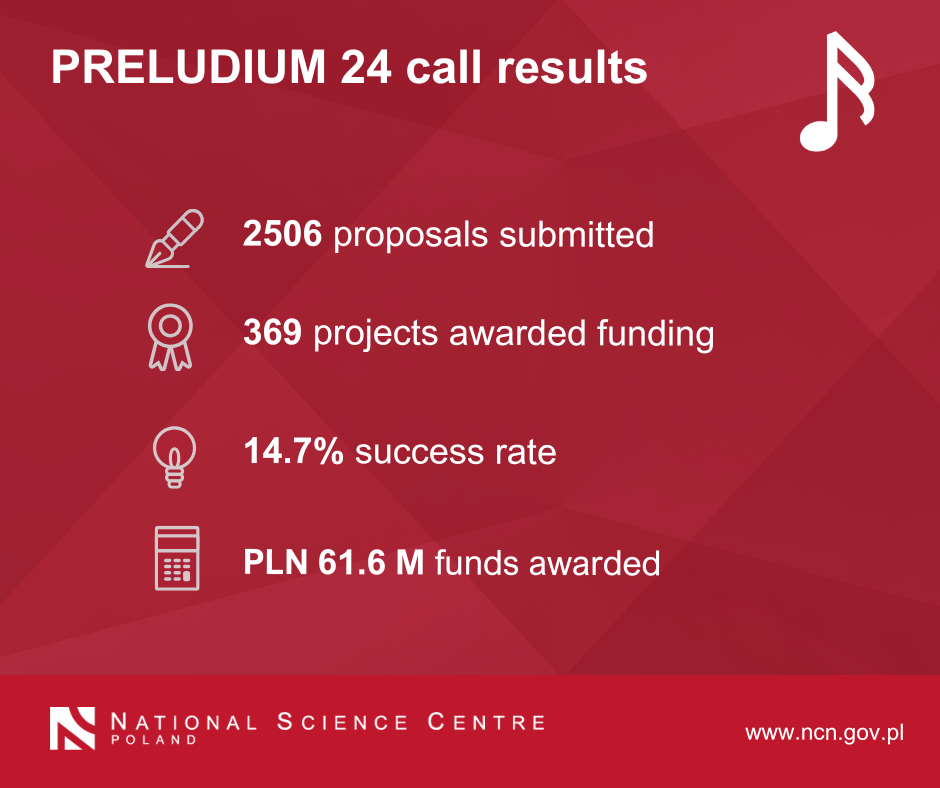
In PRELUDIUM 24, 2,506 proposals were submitted; 758 were evaluated in the second stage, and ultimately 369 proposals were recommended for funding, with a total value exceeding PLN 61.6 million. The success rate was 14.72%.
The OPUS and PRELUDIUM editions concluded today met with record interest from the Polish research community. Compared to the calls announced a year earlier, a clear increase in the number of submitted proposals was recorded — OPUS received 11% more proposals than in the previous year, while PRELUDIUM recorded an increase of 19%. These figures show that researchers working in Poland are active, have excellent research ideas and — importantly — wish to pursue them in Poland.
The budget allocated by the NCN Council to OPUS 29 represents the highest budget in nominal terms for this type of call since the establishment of NCN. However, due to the NCN’s budgetary constraints, this increase remains insufficient and does not meet the demand expressed by the Polish research community. The costs of conducting research continue to rise, which increases the average cost intensity per project and significantly affects success rates in the call.
| 2025
OPUS 29 |
2024*
OPUS 27 |
2025
PRELUDIUM 24 |
2024
PRELUDIUM 23 |
|
|---|---|---|---|---|
|
submitted proposals |
2,538 |
2,255 |
2,506 |
2,104 |
|
funded proposals |
344 |
357 |
369 |
362 |
|
amount of funding |
PLN 636.1 mln |
PLN 603.6 mln |
PLN 61.6 mln |
PLN 61.2 mln |
|
cost intensity (average, approximate per project) |
PLN 1.85 mln |
PLN 1.69 mln |
PLN 167,000 |
PLN 169,000 |
* The comparison does not include the OPUS 28 call, which additionally included the LAP/Weave pathway and is therefore not directly comparable with the spring editions of the OPUS calls.
How were the proposals evaluated?
Proposals were evaluated in accordance with a two-stage peer-review merit-based evaluation procedure conducted within discipline panels. This evaluation model has been applied by NCN since the first edition of its calls in 2011. At each of the two stages, a proposal receives at least two expert reviews. The final evaluation is not simply an aggregation of these reviews but is discussed and determined by the Expert Team at the meeting. Experts draw up their recommendations based on their knowledge and competence. Experts responsible for the evaluation of proposals at NCN are selected by the NCN Council on the basis of scientific excellence and the absence of conflicts of interest. Currently, 99% of reviews prepared within NCN call procedures are authored by foreign experts.
Webinar for PRELUDIUM winners
Winners of the PRELUDIUM 24 call who will be implementing their first research project funded by NCN are welcome to take part in a pilot training webinar on the implementation of research projects. During the meeting, we will present key information concerning signing of the agreement, the introduction of changes, and project reporting, which may prove helpful during the project implementation phase.
The webinar will take place on 9 December 2025 at 10:00 a.m. on the ClickMeeting platform. Invitations will be sent by email to the address of the principal investigator provided in the proposal.